Whiskey History
Why Irish Whiskey Collapsed After Its 19th-Century Peak
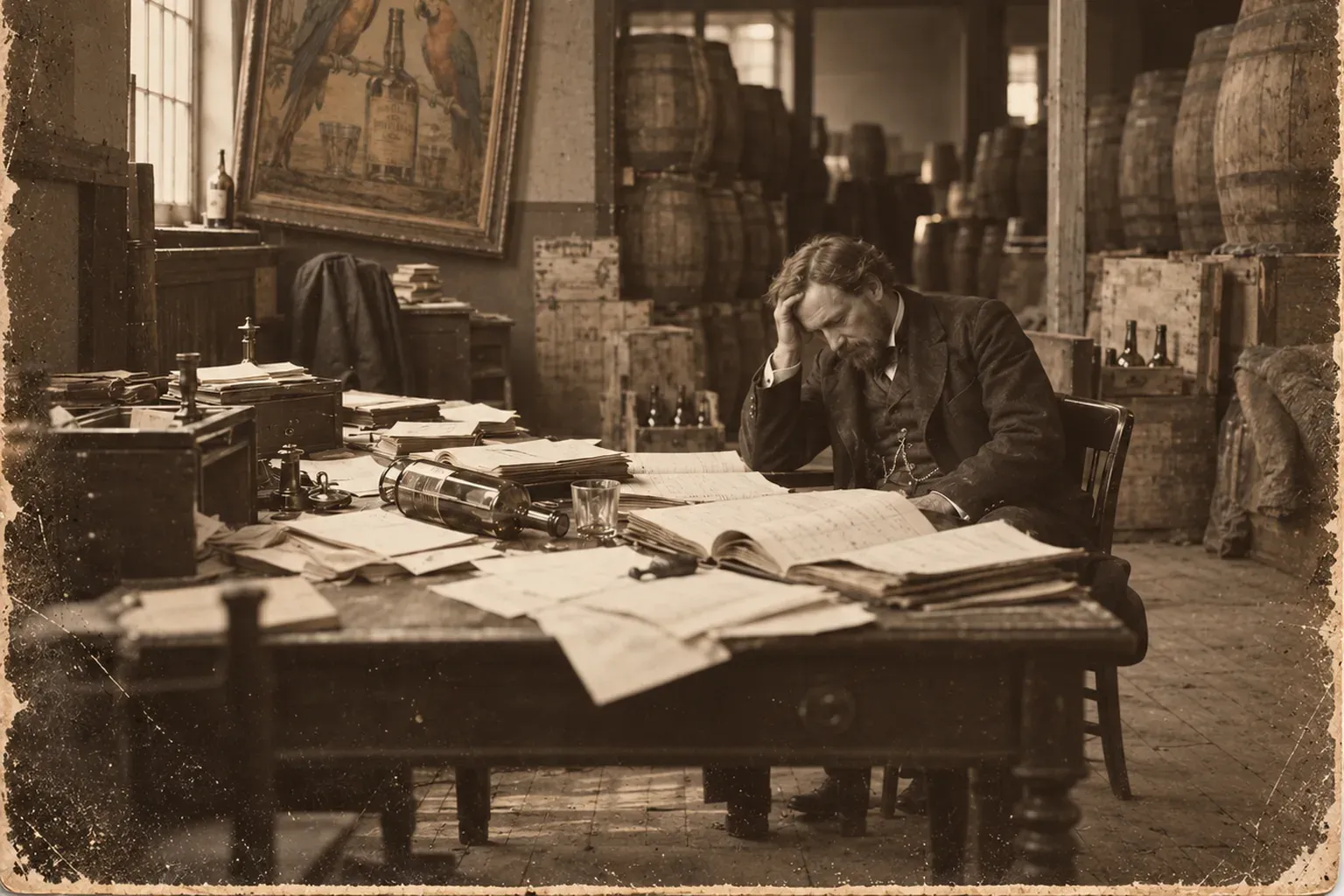
For much of the 19th century, Irish whiskey was among the most respected spirits sold in Britain and its export markets. Dublin whiskey in particular was a byword for quality. Within a few decades of 1900, most of that industry had gone. The final blows landed in the 20th century, but the causes were set earlier: a technical choice, a legal change that favoured blending, and a house style that the market slowly left behind.
An industry built on the pot still
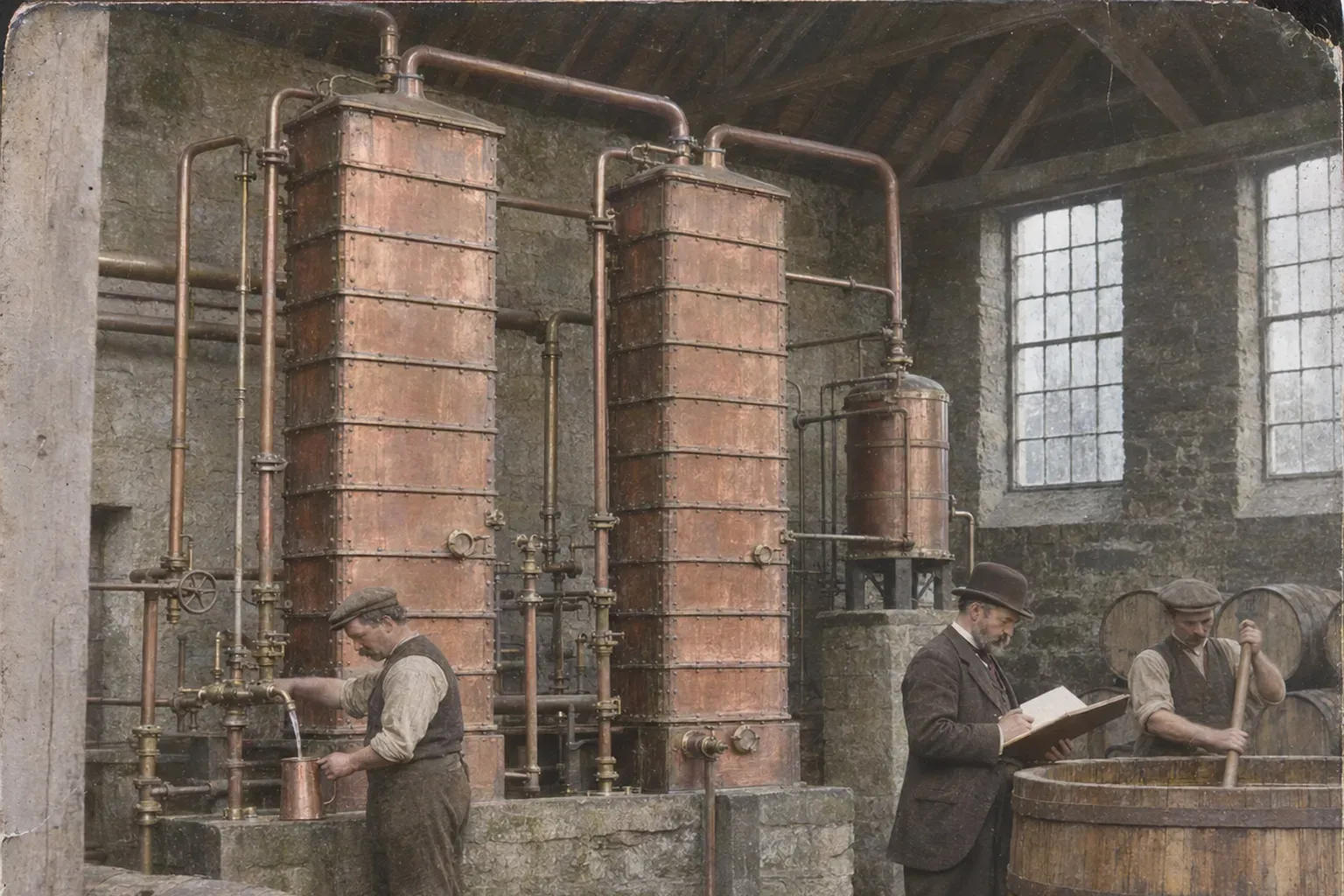
Irish whiskey of the period was pot still whiskey. A pot still is a large copper vessel that distils in separate batches. It keeps much of the character of the grain, and the spirit it produces is heavy, oily and full-bodied.
Many Irish distillers worked from a mixed mash of malted and unmalted barley, sometimes with other grains. Historians commonly link this practice to the taxation of malt: unmalted grain carried less duty. Triple distillation was widespread. The result was a distinctive, weighty spirit that had a loyal following.
The large Dublin houses were industrial operations, not farm stills. Alfred Barnard’s survey The Whisky Distilleries of the United Kingdom, published in 1887, describes them as substantial city sites with their own maltings, warehouses and workforces. By the measure of reputation, the late 19th century was close to a high point.
The still that Ireland turned down
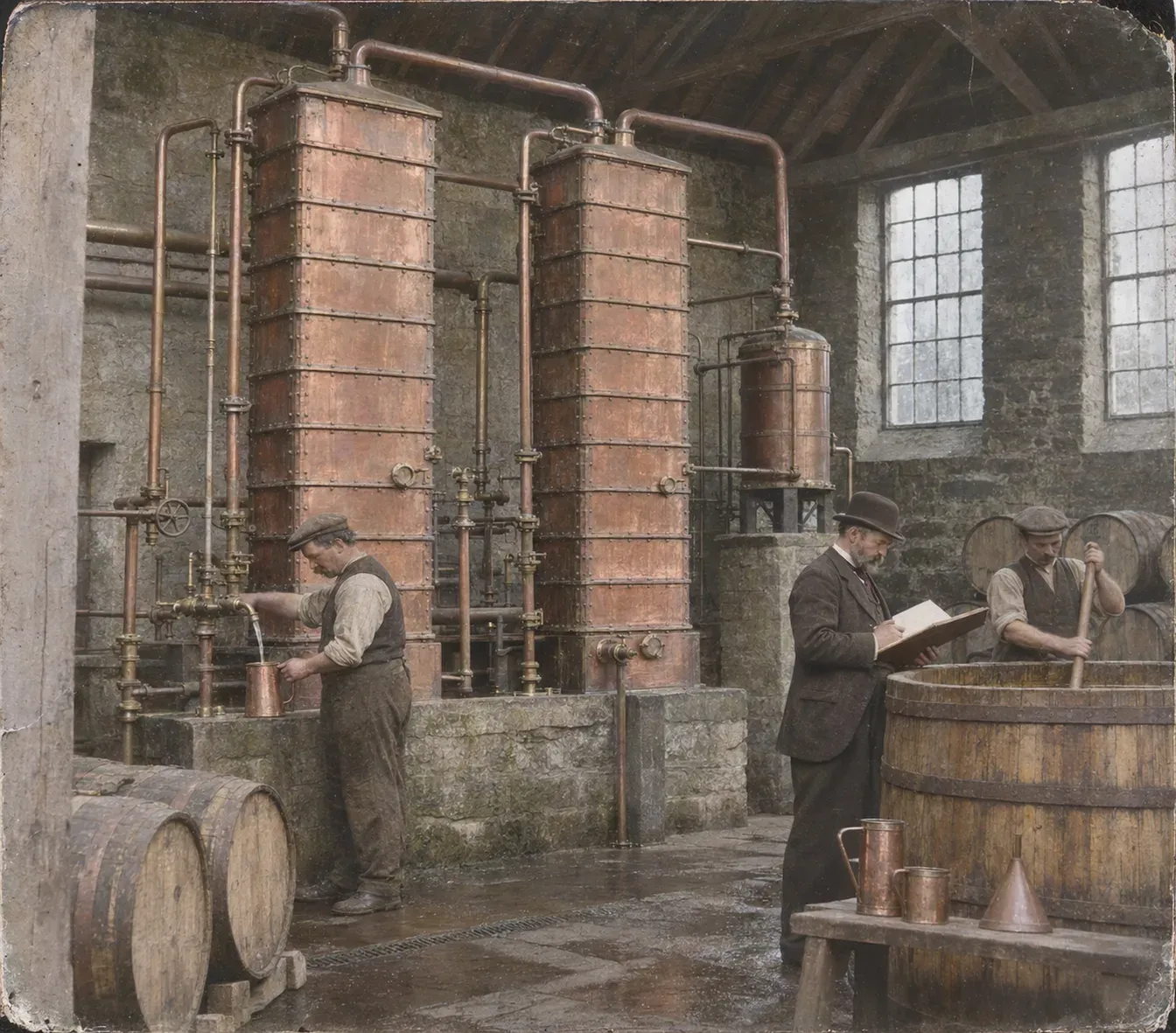
The technology that would undermine this position came from an Irishman. Aeneas Coffey, a former excise official in Ireland, patented an improved continuous still in 1830.
A continuous still, also called a column still or patent still, does not work in batches. Wash goes in at one end and spirit comes out at the other, without stopping. It produces spirit at a much higher strength, with a lighter character, and at a lower cost per litre than a pot still.
The leading Dublin distillers largely refused it. Their view was that the lighter spirit from a column still was not whiskey in any meaningful sense. Coffey found his customers elsewhere, notably among Scottish producers who used the still to make grain whisky. Some Irish distillers, particularly in Belfast and Derry, did install patent stills, and part of their output went to blenders.
Explore Whisky Casks on cask.directory
cask.directory connects buyers directly with producers, brokers and independent bottlers offering whisky, rum, cognac, armagnac, calvados and other mature spirits casks.
Blending changes the market
Grain whisky on its own had limited appeal. Blended with malt whisky, it became something new. A blend is a combination of whiskies from several distilleries, usually malt and grain, assembled to a consistent recipe.
A change in British law made this commercially practical. The Spirits Act 1860 allowed whiskies to be blended while still in bond, that is, in a duty-suspended warehouse before excise duty was paid. Merchants could now build blends at scale without paying duty on every component first.
Blended Scotch had several advantages over Irish pot still whiskey:
- Consistency. A recipe drawing on many distilleries could taste the same from one year to the next.
- Cost. Grain whisky from column stills was cheaper to produce than pot still spirit.
- Style. The lighter profile suited a wider public, including drinkers who mixed whisky with water or soda.
- Branding. A blender owned a name and a recipe, not a single site, and could promote that name across the Empire.
The timing also helped. In the later 19th century, the phylloxera epidemic devastated French vineyards and disrupted cognac supply. Historians often cite this as one reason British drinkers turned towards whisky as an alternative to brandy, and blended Scotch was well placed to take that demand.
A style out of step
Irish distillers did not ignore the threat. In 1878, four Dublin firms, John Jameson & Son, William Jameson & Co., John Power & Son and George Roe & Co., published a pamphlet titled Truths About Whisky. It argued that spirit from patent stills was “silent spirit”, not whiskey, and that blends sold as whiskey misled the public.
The argument was coherent, but it was a defence of quality against a market that increasingly wanted something else. Irish pot still whiskey stayed heavy while public taste moved towards lighter, cheaper and more consistent blends.
The structure of the Irish trade added to the difficulty. Much Irish whiskey left the distillery in cask and was bottled by merchants and bonders, who sold it under their own labels. Distillers therefore had less direct control over brands than the large Scotch blending houses that were building names of their own.
Try our Ultimate Cask Calculator to Compare Offers and Estimate Bottling Yields
Discover our free Whisky Cask Calculator to compare cask offers, estimate bottling yield, calculate cost per bottle, and make smarter whisky cask investment decisions with confidence.
The question of what whiskey is
The dispute came to a head in the early 20th century. A prosecution brought in the London borough of Islington in 1905 tested whether spirit containing patent still grain could be sold as whiskey. The case led to a Royal Commission on Whiskey and Other Potable Spirits, which reported in 1909.
The Commission declined to restrict the word “whiskey” to pot still spirit. In practice, this endorsed blends and grain whisky as legitimate whiskey. The central Irish argument, that only pot still spirit deserved the name, no longer had legal backing.
The 20th-century blows
An industry already losing ground was then hit by a series of political and commercial shocks:
- Independence and partition. The War of Independence and the creation of the Irish Free State changed Ireland’s relationship with the British and imperial markets on which Irish distillers depended.
- The Anglo-Irish trade war. In the 1930s, tariffs between Britain and the Free State further restricted access to the largest export market.
- US Prohibition. From 1920 to 1933, legal sales to the United States stopped. When the market reopened, Scotch producers were generally better placed to supply it with stock and established brands.
Distilleries closed one after another. From dozens of working sites across Ireland in the 19th century, the industry contracted to a handful by the middle of the 20th. In 1966, the remaining distillers in the Republic, John Jameson & Son, John Power & Son and Cork Distilleries Company, merged to form Irish Distillers. Production was later concentrated at a new distillery at Midleton, in County Cork, while Bushmills continued in Northern Ireland.
The revival of Irish whiskey
The contraction did not last. From the late 1980s, Irish whiskey began a long recovery. In 1987, John Teeling founded Cooley Distillery in County Louth, an independent producer outside the Irish Distillers group. It gave the market a second source of Irish spirit in the Republic, including stock that could be sold to other brands.
Since then, new distilleries have opened across the island, north and south. Dublin, the centre of the 19th-century trade, has working distilleries again. Teeling’s distillery in the Liberties, opened in 2015, is commonly described as the first new distillery in the city for more than a century. Many of these sites are young, so their oldest casks are correspondingly young, and much of the mature Irish whiskey on the market still comes from a small number of long-established producers.
Independent bottlers have played a visible part in this revival. An independent bottler buys casks or stock from a distillery and bottles the whiskey under its own label, often as a single cask or at cask strength, meaning without dilution. For a long time, the Irish stock available to them was scarce, because so few distilleries were operating. As supply has widened, more independent Irish bottlings have appeared, showing distillery characters, cask types and ages that the core brands do not. Some firms have also revived the old practice of whiskey bonding: buying new-make spirit (freshly distilled spirit that has not yet been matured) or young whiskey, maturing it in their own casks and selling it under their own name. Mitchell & Son’s Green Spot, a bonder’s label that survived the long decline, is often cited as a link between the two eras.
Whisky lovers have followed. Pot still whiskey, the heavy style the Dublin houses defended in 1878, has returned as a recognised Irish category: “single pot still” is defined under the Irish whiskey rules, and enthusiasts seek it out for the weight and texture that once put it out of fashion. Interest in single casks, distillery provenance and cask finishes has grown alongside it. For anyone buying or selling an Irish cask, the details that matter echo the dispute of 1905: the distillery of origin, the type of spirit (pot still, malt or grain), the fill date and the cask type.